Fib Is a Menu. 2.6 Is a Decision.
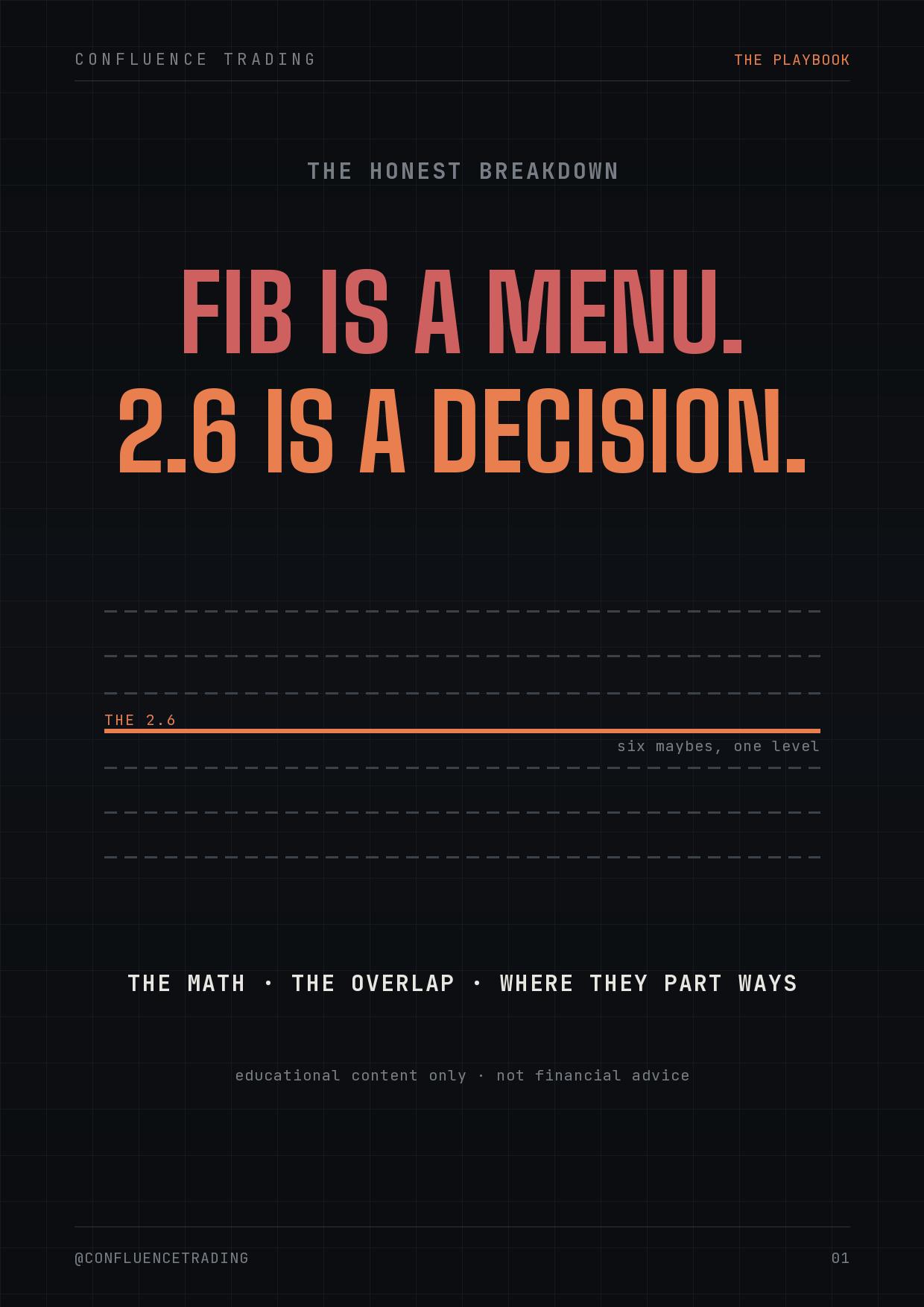
This is the honest breakdown. No strawmen, no pretending the 2.6 fell out of the sky, and no pretending Fibonacci is nonsense. Fibonacci retracements are used by millions of traders and the levels are drawn on more charts than any other tool in existence. The concept is not the problem.
The problem is that a tool which offers six answers to one question cannot be executed with discipline. This playbook shows you the honest math connecting Fibonacci to the 2.6, the exact point where the two part ways, and how to test everything yourself on your own chart. Nothing here requires trusting me.
The Fib problem
Draw a Fibonacci retracement on any impulse and you get six levels: 0.236, 0.382, 0.5, 0.618, 0.705, 0.786. Now watch what happens psychologically.
Hindsight accuracy
Every pullback in history stopped near one of six lines, because six lines cover most of the range. Scroll back on any chart and Fibonacci looks like prophecy. That feeling of accuracy is a property of coverage, not prediction. A tool that is always right in hindsight has told you nothing about the next trade.
Live paralysis
In real time the same coverage becomes a menu. Price approaches the 0.382. Do you enter, or wait for the 0.5? It slices through. The 0.618 then, the famous one? Or is this the deep 0.705 day? You either freeze, or you enter three times, or you redraw the swing until the chart agrees with the trade you already wanted. The tool did not give you a decision. It gave you permission for every decision.
The redraw disease
Because the anchor points are discretionary, two traders draw two different retracements on the same move, and the same trader draws a third one after the trade fails. When the inputs are negotiable, the output is unfalsifiable — and unfalsifiable is untradeable.
The honest math
Here is the part most pages would hide, stated plainly. Divide 1 by 2.6 and you get 0.3846. The classic Fibonacci retracement is 0.382. Those two numbers are a rounding distance apart. This is not a coincidence I am dodging. It is the point.
The duality
Measure an impulse from low to high. Take the range and divide it by 2.6, then subtract that distance from the high. The level you get sits approximately 38.2% below the high, which is the exact same price as 61.8% above the low. One line, two Fibonacci names, depending on which end you measure from. The 2.6 level lives inside the golden zone. It always has.
So no, this is not different math. It is a different relationship with the same zone — one calculation instead of a six-line overlay.
Where they part ways
If the zone is the same, why delete Fibonacci? Because trading is execution, and in execution the two tools have nothing in common.
- One price vs six. The 2.6 outputs a single number. A limit order can rest at a single number. It cannot rest at a menu.
- Placed in advance. Because the level exists the moment the impulse completes, the order waits for price. Fib traders decide during the pullback, which is exactly when judgement is worst.
- No swing negotiation. The impulse is defined by rules: the move between the wick extremes, confirmed by body closes. Same input, same output, any trader, any day.
- No redraws. One measurement per impulse. If price invalidates the impulse, the trade is dead. The level never migrates to rescue a losing idea.
- It can say no. This is the big one — and it gets its own section.
None of these five points argue about which math is superior. They are all about what a human being can execute repeatedly under stress. Discipline is a scarce resource. A tool that spends less of it wins.
The skip engine
With six levels on screen, every entry you are tempted by can find a line to justify it. Fib always says yes. That is not a feature. A tool that cannot refuse you is a permission slip, not a filter. Here is how the 2.6 says no.
- No touch, no trade. If price never reaches the level, there is no trade. Full stop. No "it respected the 0.5 instead".
- No agreement, no trade. If the POC or session VWAP disagrees with the level, skip. Independent tools must point at the same price.
- No pool, no trade. If there is no liquidity pool beyond the level to act as a target, the geometry has no payout. Skip.
- Wrong session, no trade. The setup performs in its session. Outside it, the same picture is a different market. Skip.
Every skipped B-grade trade is spread not paid, a loss not taken, and discipline not spent. Over a year, the trades you did not take are the quiet difference between a flat equity curve and a rising one. The menu never gave you that option — it was always serving something.
The full procedure
- 1Define the impulse. One decisive directional leg. Measure wick extreme to wick extreme. A body close against the direction ends the leg.
- 2Measure and divide. Range = high minus low. Divide the range by 2.6.
- 3Project the level. For a long: high minus the division. For a short: low plus the division. Write the exact price down.
- 4Check the stack. POC or VWAP agreeing at the level. A pool beyond it for the target. The right session. Five yes answers or no trade.
- 5Place and walk away. Limit order at the level, stop beyond the wick zone of the impulse origin, target at the pool. The trade now needs you for nothing.
The geometry dividend
Because the 2.6 entry sits deep in the pullback, it lives next door to invalidation. The distance to wrong is short by construction, so the stop is small. The target is the pool across the range, so the journey is long. Small risk unit, long distance: that is where the multi-R payouts come from. The tight stop is not caution. It is leverage on being right.
The receipt · 4.3R
A documented gold short, posted and timestamped before the outcome.
Why the R multiple matters more than the win rate
At 4R per winner, a 20% win rate is breakeven. At 3R, 25% keeps you alive. My own journal on A+ setups runs above 65%, and that is my sample on my rules, not a promise about yours. The honest point is stronger than any win-rate claim: with multi-R geometry you do not need to be right often. Being right often is the bonus, not the requirement.
Past results never guarantee future ones. Anyone who tells you otherwise is selling something.
The 20-impulse test
Do not believe this document. Test it. Tonight, on your own chart, about twenty minutes.
- 1Open your main pair on your trading timeframe.
- 2Scroll back and mark the last 20 clean impulses, wick extreme to wick extreme.
- 3For each, divide the range by 2.6 and mark the level.
- 4Count how many pullbacks reached the level before the move continued.
- 5Count how many respected it within a few points versus sliced straight through.
- 6Note what the sliced ones had in common. Check them against the skip rules: wrong session, no pool, POC disagreeing.
- 7Write your numbers down. That is your sample, on your market, with your rules.
Now try running the same honest backtest on a six-level Fibonacci overlay and watch the problem appear: which level was "the" level? You cannot score a menu. You can score a number. That difference is the entire argument of this playbook, demonstrated by your own chart.
The objections
"So it is just Fib."
The zone is shared, and this document said so. The execution is not shared. If you believe one resting order at one price is the same as six discretionary lines, run the 20-impulse test on both and score them.
"Why 2.6 and not 2.618?"
Because 48.7 divided by 2.6 is mental math at the screen and 2.618 is not, and because the difference on a normal impulse is a fraction of a point, far inside the spread. Precision that costs speed and buys nothing is decoration.
"Does it work outside gold?"
The geometry is market-neutral: impulses, pullbacks and pools exist everywhere. On options, measure the underlying, not the premium chart. On crypto, expect wider tails and size the stop for them. The skip rules matter more, not less, in wilder markets.
"Which timeframe?"
The one you actually trade, with the chart above it as the referee. A higher-timeframe impulse in the opposite direction outranks your entry. This is the same hierarchy as every other tool.
"What if price never comes?"
Then there was no trade, and that is the system working. The order expires with the setup. Chasing the move you missed is how the market converts patience back into inventory.
The checklist
Nine questions before any 2.6 trade. A single no means wait or skip.
- 1Is the impulse clean, decisive, and finished by a body close?
- 2Measured wick extreme to wick extreme?
- 3Range divided by 2.6, level written as an exact price?
- 4Does POC or session VWAP independently agree at the level?
- 5Is there a liquidity pool beyond the level to act as the target?
- 6Is this the right session for the setup?
- 7Is the limit order resting before price arrives?
- 8Is the stop beyond the wick zone, sized so the loss is boring?
- 9Does the target pay at least 2R, ideally more?
Five structural yes answers make it an A+. Four make it a B. You already know the rule: do not trade Bs.
The last word
Fibonacci was never the enemy. Vagueness was. The golden zone is real, and the honest math in this document shows the 2.6 lives inside it. The difference is that a menu asks you to be disciplined six times per pullback, and a single resting price asks you once, in advance, when you are calm.
Fib is a menu. The 2.6 is a decision. Make yours before price arrives.
Disclaimer
This is educational content only. It is not investment advice, not portfolio management, and not a recommendation to buy or sell any instrument. Trading leveraged products carries a high level of risk and most retail traders lose money. Any performance figures mentioned are the author's own journaled sample and are not indicative of future results, yours or anyone's. Every trading decision you make, and its outcome, is yours alone.
MarketScore turns the process in this article into scanners, alerts and an options analyzer built for Indian and global markets.
Get MarketScore